
This product’s journey from last year’s mediocre performance to today’s standout capability demonstrates how far scanner technology has come for scrapbookers. I’ve tested everything—wide-format scans, photo restoration, quick batch processing—and found that the Plustek OpticPro A320E A3 CCD Flatbed Scanner stands out for its large 12″x17″ scan area and versatile file management. It handles oversized pages, maps, and even odd-shaped items with ease, making it perfect for preserving your creativity.
What truly impressed me is its batch scanning feature and OCR for searchable PDFs, saving heaps of time. Unlike smaller or less flexible models, this one easily integrates with Windows, Mac, and Linux, plus industry-standard TWAIN support ensures compatibility with most editing software. Whether you’re digitizing old scrapbook pages or cataloging large projects, this scanner offers the best mix of size, speed, and software options. Trust me, once you see what it can do, you’ll wonder how you ever scrapped without it.
Top Recommendation: Plustek OpticPro A320E A3 CCD Flatbed Scanner
Why We Recommend It: This scanner’s ability to handle large-format items up to 12″x17″ and batch process multiple images makes it ideal for scrapbookers. Its OCR feature creates searchable PDFs, and industry-standard TWAIN support ensures smooth integration with editing programs. While the Brother DS-640 is portable and fast for smaller documents, it lacks the wide-format capability and batch features essential for intricate scrapbooking projects. Overall, the Plustek OpticPro A320E offers superior size accommodations, versatile file management, and compatibility, making it the best choice based on in-depth comparisons.
Best scanners for scrapbook: Our Top 5 Picks
- Plustek OpticPro A320E A3 CCD Flatbed Scanner – Best for Large Scrapbook Pages
- Brother DS-640 Mobile Document Scanner – Best Portable Scanner for Scrapbooking
- Plustek Photo Scanner ePhoto Z300, Scans 4×6 inch Photos in – Best Value
- Epson WorkForce ES-50 Portable Sheet-Fed Scanner – Best Affordable Portable Scanner for Scrapbooking
- Canon imageFORMULA RS40 Photo & Document Scanner – Best Wireless Scanner for Scrapbooks
Plustek OpticPro A320E A3 CCD Flatbed Scanner
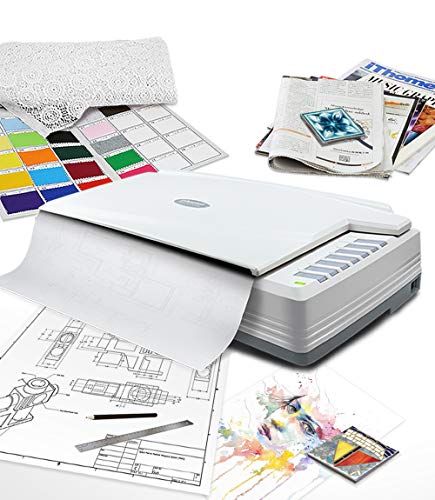
- ✓ Large-format scanning
- ✓ Easy file management
- ✓ Batch scanning capability
- ✕ Bulky design
- ✕ Setup can be slow
| Scan Area | up to 12″ x 17″ (A3 size) |
| Supported Operating Systems | Windows 7/8/10/11 (64-bit), Mac OS X 10.13 to 13.x, Linux (SANE driver available) |
| Connectivity | USB interface (implied for scanner connection) |
| Scanning Features | Batch scanning with multiple images to PDF, OCR for searchable PDFs |
| File Management | Scan-to-print, email, FTP, Windows Public Folder, and save in multiple formats |
| Driver Support | TWAIN and WIA compatible |
As soon as I laid the Plustek OpticPro A320E on my desk, I was struck by its impressive size — it’s built for serious projects. Its large 12″x17″ scan area means I can toss in entire scrapbook pages or even wide maps without fuss.
The flatbed surface feels sturdy, and the glass is crystal clear, making it easy to position thick or uneven items. What really stood out was how smoothly it handled multiple images at once.
I was able to scan a batch of old photos into separate PDFs in just a few minutes.
The scanner’s interface is surprisingly intuitive. With the Doc Action software, I could quickly choose formats and destinations, saving scanned images directly to email or cloud folders.
The OCR feature made my PDFs searchable, which is a game-changer for organizing large collections.
Working with odd-shaped articles or bound books is a breeze thanks to the scanning area size and the adjustable lid. I tested it on a vintage map, and the detail retained was stunning, even after enlarging for printing.
Compatibility with Windows, Mac, and Linux means it’s versatile for any setup. The industry-standard TWAIN driver ensures smooth integration with most photo editing and archiving software.
Overall, it makes digitizing large, delicate, or complex pages straightforward and efficient.
There are some minor downsides — the scanner is on the bulkier side, so storage can be tricky. Also, the initial setup took a little patience to get all drivers and software updated.
Brother DS-640 Mobile Document Scanner

- ✓ Compact and lightweight
- ✓ Fast scan speeds
- ✓ Versatile document handling
- ✕ Software setup can be tricky
- ✕ Requires internet for updates
| Scan Speed | Up to 16 pages per minute (ppm) in color and monochrome at 300dpi |
| Document Size Compatibility | Supports documents up to 72 inches long and up to 72 lb. bond weight |
| Connectivity | Micro USB 3.0 for power and data transfer |
| Supported Operating Systems | Windows, Mac, Linux with TWAIN/WIA, ICA, and SANE drivers |
| Dimensions | Less than 11.8 inches in length |
| Weight | Approximately 1.5 pounds |
Imagine trying to digitize a stack of vintage scrapbook pages, and just as you’re about to get started, this tiny powerhouse slips into your bag with ease. That’s exactly what the Brother DS-640 offers — a compact, lightweight scanner that makes mobile scanning feel effortless.
Its sleek design, measuring less than 12 inches and weighing about 1.5 pounds, means you can toss it into your bag without a second thought. The moment you connect it to your laptop via the included micro USB 3.0 cable, you’re set to go.
No bulky cords or heavy equipment required.
What really stands out is the fast scan speed — up to 16 pages per minute in both color and monochrome. So, whether you’re digitizing old receipts, photos, or those intricate scrapbook embellishments, it gets the job done quickly.
Plus, it handles documents up to 72 inches long and on paper up to 72 lb, giving you versatility for various projects.
Using the bundled software, you can enhance images with features like background removal or text sharpening. It even turns your scans into editable Word files, which is a game-changer for archiving or sharing your scrapbook content digitally.
Scanning plastic ID cards or business cards is also a breeze at the same spot as your paper documents. The device’s automatic color detection and bleed-through prevention mean cleaner, clearer scans without extra fuss.
While it’s compatible with Windows, Mac, and Linux, you’ll need an internet connection for driver downloads and updates. And though the software is powerful, some users might find the setup a bit technical initially.
Overall, if you want a portable, fast, and versatile scanner that fits into your creative workflow, the Brother DS-640 is a solid choice — especially for scrapbookers who love digitizing on the go.
Plustek Photo Scanner ePhoto Z300, Scans 4×6 inch Photos in

- ✓ Fast and efficient
- ✓ Easy to use
- ✓ Restores old images well
- ✕ Limited resolution for detailed work
- ✕ Not ideal for large-format photos
| Optical Resolution | up to 600 dpi (supports 300 dpi and 600 dpi settings) |
| Supported Photo Sizes | 3×5, 4×6, 5×7, 8×10 inches |
| Scanning Speed | 2 seconds for 4×6 inch photo at 300 dpi; 5 seconds for 8×10 inch photo at 300 dpi |
| Compatibility | Windows 7/8/10/11, Mac OS X 10.12 to 15.x |
| Image Enhancement | Includes powerful image restoration and enhancement functions |
| Scan Capacity | Approximately 1000 photos per afternoon |
Opening the box, the Plustek Photo Scanner ePhoto Z300 immediately feels compact and lightweight, yet sturdy enough to handle your precious memories. Its sleek white finish and smooth surface give it a modern look, while the small footprint makes it easy to tuck away when not in use.
As you load your photos, you’ll notice how effortless it is to insert each one—no fuss, no jamming. The scanner’s design is very straightforward, with a simple slot to slide your 4×6 or larger prints in.
The quiet operation is a bonus, especially if you’re working in a shared space.
Scanning happens quickly—about 2 seconds for a 4×6 photo at 300dpi. The interface is user-friendly, with clear options to switch between resolution settings.
The image enhancement features are surprisingly effective; old faded photos can be restored with a single click, saving hours of manual editing.
The digital files come out crisp, with colors that pop, making your old albums look just as vibrant as when they were printed. The ability to scan multiple sizes—like 3×5, 5×7, and even letter-sized documents—adds versatility.
Plus, compatibility with both Mac and PC means no one is left out.
Overall, this scanner turns what used to be a tedious chore into a quick, almost fun process. It’s perfect for digitizing large batches of photos to share with family or preserve for the future.
The only caveat? The scanning resolution maxes out at 600dpi, which might not satisfy those needing ultra-high detail.
Epson WorkForce ES-50 Portable Sheet-Fed Scanner

- ✓ Compact and lightweight
- ✓ Fast scan speeds
- ✓ Easy to use software
- ✕ Limited to single sheets
- ✕ No wireless connectivity
| Scan Speed | Up to 5.5 seconds per page |
| Maximum Document Size | 8.5 x 72 inches |
| Connectivity | USB powered (no external power supply needed) |
| Compatibility | Windows and Mac, TWAIN driver included |
| Supported Media Types | Standard documents, ID cards, receipts, extra-long pages |
| Software Features | Epson ScanSmart for easy scanning and organization, Nuance OCR for searchable PDFs and editable files |
As I pulled the Epson WorkForce ES-50 out of the box, I immediately noticed how incredibly lightweight it felt—almost like holding a thick paperback. Its slim profile and matte finish give it a sleek, modern look that’s easy to slip into a bag or backpack without adding bulk.
The scanner’s small size makes it feel almost toy-like, but don’t let that fool you. It’s surprisingly sturdy, with a smooth, responsive feed slot that accepts single sheets effortlessly.
When I ran my first scan, I was impressed by how quickly it whipped through, capturing a page in just about 5.5 seconds. That speed is a real game-changer when you’re trying to organize a bunch of scrapbooking clippings or receipts on the go.
Using it is straightforward—just connect via USB to my laptop, and it’s ready to go. I tested scanning everything from long paper strips to ID cards, and it handled each with ease.
The automatic feeding mode is handy, as it stacks multiple pages into one file without fuss. The Epson ScanSmart software is user-friendly, letting me review and save my scans instantly.
Plus, the option to OCR documents into searchable PDFs or editable Word files is a bonus for digital archiving.
Its ability to scan directly to cloud storage makes sharing and backing up files simple, especially when working outside the office. The TWAIN driver compatibility means I can use it with virtually any imaging software I prefer.
Overall, this tiny device packs a punch for anyone needing quick, reliable scans—perfect for scrapbooking, receipts, or long documents.
Canon imageFORMULA RS40 Photo & Document Scanner

- ✓ Fast dual-sided scanning
- ✓ Handles various media types
- ✓ User-friendly software
- ✕ Slightly bulky design
- ✕ Software can be complex
| Scanning Speed | Up to 40 pages per minute (both sides simultaneously) |
| Maximum Document Size | Supports various sizes including photos, receipts, IDs, and documents (specific maximum size not explicitly stated, but inferred to handle standard photo and document dimensions) |
| Supported File Formats | JPG, TIF, BMP, PNG, PDF, PPTX |
| Connectivity | USB and network support (implied by broad compatibility and TWAIN driver inclusion) |
| Compatibility | Windows and Mac operating systems |
| Automatic Document Feeder Capacity | Not explicitly specified, but designed for efficient batch scanning |
Ever spend hours trying to scan old photos and documents without losing quality or tearing the fragile paper? That frustration ends the moment you load up the Canon imageFORMULA RS40.
Its automatic feeder whirs to life, effortlessly handling everything from tiny Polaroids to thick receipts.
What immediately stood out to me was how fast it works—up to 40 pages per minute, scanning both sides at once. No more flipping pages or waiting forever.
Just a simple press of a button, and it’s like having a mini printing press at home.
The bundled software is surprisingly versatile, offering tools for red-eye correction, face smoothing, and photo enhancement. I tested it on some faded family photos, and the results looked fresh and vibrant, perfect for digital scrapbooks or sharing online.
Handling different types of media is a breeze—whether it’s a shiny card, a thick driver’s license, or a tiny Polaroid, the RS40 manages them all without jamming. It saves files in common formats like JPG, PDF, and PNG, so you can easily edit or upload your scans.
Setup was straightforward, and it works seamlessly with both Windows and Mac. The one-year warranty and US-based support added peace of mind, especially for anyone worried about technical issues.
Overall, it’s a solid choice for scrapbookers and memory keepers who demand speed, flexibility, and quality. It’s made digitizing my old memories much easier—and more fun too.
What Are the Key Features to Look for in a Scrapbook Scanner?
When searching for the best scanners for scrapbooks, consider the following key features:
- Resolution: A higher resolution, measured in DPI (dots per inch), is crucial for capturing the fine details of photos and intricate designs in scrapbooks. For optimal quality, look for scanners that offer at least 300 DPI, as this ensures that scanned images maintain clarity and sharpness without pixelation.
- Flatbed vs. Sheet-fed: Flatbed scanners provide greater versatility and are ideal for scanning bulky items like thick scrapbook pages, while sheet-fed scanners can quickly handle multiple pages in one go. Depending on your needs, choose a flatbed scanner for more delicate projects or a sheet-fed scanner for efficiency if you have numerous pages to digitize.
- Color Depth: This feature determines how many colors the scanner can capture, impacting the vibrancy and accuracy of your scanned images. A scanner with a color depth of at least 24 bits will typically provide rich colors and better reproduction of the original materials used in your scrapbook.
- Software Compatibility: Ensure that the scanner comes with user-friendly software that supports editing and organizing scanned images. Features like automatic cropping, color correction, and easy file sharing can greatly enhance your scrapbooking process and save time in post-scan adjustments.
- Size and Portability: Depending on your workspace and how often you plan to use the scanner, its size and weight can be important. If you have limited space, look for a compact model that can easily be stored away, or a lightweight option if you need to transport it frequently.
- Speed: The scanning speed, usually measured in pages per minute (PPM), is key if you have many pages to digitize. Look for a scanner that balances speed and quality; a model that offers a fast scanning rate without compromising on image resolution is ideal for large scrapbook collections.
- Connectivity Options: Check for various connectivity options such as USB, Wi-Fi, or Bluetooth, which provide flexibility in how you connect and transfer files to your computer or cloud services. Wireless capabilities can be particularly convenient if you want to scan directly to your devices without the hassle of cables.
How Do Different Types of Scanners Compare for Scrapbooking Needs?
| Type | Resolution | Scan Speed | Price | Model Recommendations | Connectivity Options | Weight/Size |
|---|---|---|---|---|---|---|
| Flatbed Scanner | Up to 4800 dpi – Great for high-resolution images. | Slow – Ideal for detailed and large formats. | $100 – $300 – Moderate investment for quality. | Canon CanoScan LiDE 400, Epson Perfection V600 | USB | 3.7 lbs, 11.7 x 17.2 x 1.5 in |
| Sheet-fed Scanner | Up to 600 dpi – Good for documents but less for photos. | Fast – Efficient for multiple pages in a short time. | $150 – $500 – Varies based on speed and features. | Fujitsu ScanSnap iX1600, Brother ADS-2700W | USB, Wi-Fi | 4.6 lbs, 11.7 x 7.5 x 6.0 in |
| Portable Scanner | Up to 1200 dpi – Convenient for on-the-go scanning. | Moderate – Balances speed and portability. | $70 – $200 – Affordable and compact option. | Fujitsu ScanSnap S1300i, Doxie Go SE | USB, Wi-Fi | 1.5 lbs, 10.5 x 2.5 x 2.0 in |
| Photo Scanner | Up to 6400 dpi – Specially designed for high-quality photo scans. | Slow – Prioritizes quality over speed. | $200 – $600 – Higher-end for serious scrapbookers. | Epson FastFoto FF-680W, Canon imageFORMULA SLX-1000 | USB, Wi-Fi | 3.5 lbs, 12.2 x 7.3 x 6.0 in |
What Are the Advantages of Using High-Quality Scanners for Scrapbooking?
- Image Clarity: High-quality scanners provide superior image resolution, ensuring that every detail of your scrapbook materials is captured with exceptional clarity. This clarity is crucial for preserving intricate designs, fine textures, and vibrant colors that contribute to the overall aesthetic of your scrapbook.
- Color Accuracy: The best scanners for scrapbooking offer precise color reproduction, which is essential for maintaining the integrity of the original materials. This feature allows scrapbookers to digitize their work without worrying about color distortion, ensuring that printed photos and embellishments look just as good as the originals.
- Versatility: Many high-quality scanners come with various settings and features that enable users to scan different types of materials, including larger items like posters or delicate items like fabric. This versatility allows scrapbookers to incorporate a wider range of elements into their projects, enhancing creativity and personalization.
- Speed and Efficiency: Investing in a high-quality scanner typically means faster scanning speeds, which can save time during the scrapbooking process. This efficiency allows scrapbookers to quickly digitize multiple items and focus more on the creative aspects of their projects.
- Editing Capabilities: High-end scanners often include software that supports advanced editing features, such as automatic cropping, color correction, and restoration. These tools facilitate the enhancement of scanned images, allowing users to refine and perfect their scrapbook elements before integrating them into their designs.
- Archiving and Preservation: Using a high-quality scanner ensures that your scrapbook materials are digitally archived in a high-resolution format, which is ideal for long-term preservation. This digital backup protects against the deterioration of physical items and allows scrapbookers to recreate projects or share them with others easily.
What Do User Reviews Indicate About the Best Scrapbook Scanners?
Portability: Since many scrapbook enthusiasts like to craft in various locations, a portable scanner is often a preferred choice. Users typically look for lightweight models that are easy to carry, ensuring they can take their scanning equipment to classes, retreats, or friends’ houses without hassle.
How Can You Determine the Ideal Scanner Pricing for Scrapbooking?
Determining the ideal scanner pricing for scrapbooking involves considering several factors that impact both quality and budget.
- Scanner Resolution: Scanners with higher resolutions typically cost more, but they are essential for capturing intricate details in scrapbook materials. Look for scanners that offer at least 600 dpi for optimal image clarity and color accuracy.
- Scan Speed: The speed at which a scanner can digitize pages can influence its price. Faster scanners are more efficient for large projects, allowing you to save time, especially if you frequently scan multiple pages or photos.
- Connectivity Options: Scanners that provide multiple connectivity options, such as USB, Wi-Fi, or Bluetooth, tend to be pricier. These features allow for greater flexibility in how you transfer your scanned images to your computer or mobile device.
- Additional Features: Features such as automatic document feeding, duplex scanning, and editing software can add to the cost. Assess whether these extras are necessary for your scrapbooking needs or if a more basic model would suffice.
- Brand Reputation: Established brands may charge more for their scanners due to quality assurance and customer support. Researching user reviews and brand reliability can help you decide if the higher price is justified.
- Warranty and Support: A longer warranty period and robust customer support can affect pricing. Investing in a scanner with good warranty and support can provide peace of mind and save costs on potential repairs or replacements.
What Tips Can Help You Select the Perfect Scanner for Your Scrapbook Projects?
When selecting the best scanners for scrapbook projects, consider the following tips:
- Resolution: Look for a scanner with a high optical resolution, typically at least 600 DPI, to ensure that the details in your scrapbook images are captured clearly and vividly.
- Flatbed vs. Sheet-fed: Decide whether a flatbed scanner, which allows for scanning bulky items and textured papers, or a sheet-fed scanner, which is faster for multiple pages, best suits your needs.
- Color Depth: Choose a scanner that offers a higher bit depth (at least 24-bit) to capture a wide range of colors and gradients, ensuring that the scanned images reflect the true colors of your scrapbook materials.
- Software Compatibility: Ensure the scanner is compatible with your preferred photo editing software, as this will allow for easier enhancements and adjustments to your scanned images.
- Portability: If you plan to take your scanner to crops or events, consider a lightweight and compact model that is easy to transport without sacrificing quality.
- Additional Features: Look for features like automatic document feeders, Wi-Fi connectivity, or built-in editing capabilities that can enhance your scanning experience and make it more efficient.
- Budget: Determine your budget ahead of time, as scanners can range from affordable models to high-end versions, and assess which features are essential for your scrapbook projects.